
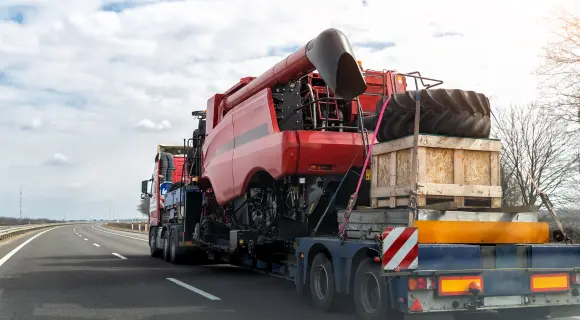
Oversize & Overweight Load Transportation
Oversize and overweight load transportation
Loads that exceed legal width, height, length, or weight — planned around state permits, escort requirements, and route restrictions.
What oversize / overweight transportation is
A load is oversize when its dimensions exceed legal limits, and overweight when its gross or axle weights do. Wide equipment, tall machinery, long structural members, and dense industrial items commonly fall into one or both categories.
Oversize/overweight (OS/OW) moves are regulated state by state. The Freight Dynamics builds the permit, escort, and routing requirements for your specific load into the transportation plan before a carrier is booked, so the quote reflects what the move actually takes.
Freight that typically needs it
- Equipment wider than 8 ft 6 in
- Machinery taller than the legal height once loaded
- Long beams, girders, piling, and structural steel
- Loads that push gross or axle weights past legal limits
- Modular and pre-fabricated components
Typical equipment
- RGN and lowboy trailers
- For tall or heavy items where deck height matters.
- Extendable (stretch) flatbeds
- For long freight such as beams and poles.
- Multi-axle configurations
- To bring axle weights within permitted limits on heavy loads.
Trailer specifications vary by carrier and state; we confirm the configuration for your load.
Planning
What shapes the plan
Legal limits, generally
On the National Network, legal width is generally 8 ft 6 in and gross vehicle weight is generally capped at 80,000 lb on Interstates. Legal height and length are set by each state. Anything beyond them requires permits.
Permits are state by state
Each state on the route issues its own permit with its own conditions — approved route, travel times, and sometimes curfews or seasonal restrictions.
Escorts and signage
Above state-specific width, height, or length thresholds, pilot/escort vehicles are required, and OS/OW loads must carry signage and flags. Requirements are confirmed for your exact dimensions and route.
Industries and use cases
- Construction & Infrastructure — Heavy equipment, structural materials, and oversize components moved on job-site schedules.
- Energy & Renewables — Electrical equipment, structural components, and project materials for generation and grid work.
- Oil & Gas — Pipe, tanks, production equipment, and heavy machinery moved to field and facility locations.
- Mining & Industrial Equipment — Heavy machinery and production equipment that need specialized trailers and careful planning.
- Agriculture & Heavy Machinery — Combines, tractors, and implements moved between dealers, farms, and auctions.
Related services
What we need to quote it
- Exact length, width, height, and weight of the item
- Origin and destination with any site access constraints
- Whether the item can be disassembled to reduce dimensions
- Pickup window and delivery deadline
- Photos or drawings, if available
Oversize / Overweight FAQs
When is an oversize permit required?
Whenever a load exceeds a state's legal width, height, length, or weight limits. Legal width is generally 8 ft 6 in and Interstate gross weight is generally 80,000 lb; height and length limits vary by state. Each state on the route requires its own permit.
Do I need escort vehicles?
It depends on your load's dimensions and the states on the route — each state sets its own escort thresholds. We confirm the requirement for your exact load when we plan the move.
Why do oversize quotes need exact dimensions?
A few inches can change the trailer, the permit class, whether escorts are needed, and the route itself. Exact length, width, height, and weight let us quote what the move really requires.
Request a oversize / overweight quote
Let's Move Your Next Shipment.
Share the load details and our team will work out the right equipment, route, and plan.